Where does money come from? Two stories at odds
Most of us learned the same story about money. Long ago, people swapped goods directly. It was clumsy: how many chickens is a cow worth? How many kilos of salt? So we invented money to make trade easier, and everything else followed. It is neat, logical and easy to remember. It is also the story that historians and anthropologists have been questioning recently. So, how did money come about?
Hypothesis 1: A solution to barter
Why not trade directly?
This hypothesis is the traditional view, the one taught in most economics textbooks. It goes back to Adam Smith and The Wealth of Nations (1776), where Smith argued that people have always been inclined to barter and exchange, and that money appeared once this became too complex. It starts from a simple problem: how do people exchange goods when they all want different things?
Let’s say I am a shoemaker and I want bread. You are a baker and you want shoes. We can trade goods directly, and this is called barter. However, it quickly becomes clear that barter isn’t a good way to trade. What if I want your bread, but you don’t want my shoes? Economists call this the “double coincidence of wants”: for a trade to happen, we both need to want exactly what the other has, at the same time. Thus, it would be nice to agree on one good that everyone wants; money was born to solve this problem.
Money simplifies and standardises transactions. How many chickens can you buy with a cow? How many chickens can a kilo of salt buy? With a hundred goods, you would need 4,950 different value comparisons, one for every pair. With a single currency, you only need a hundred prices, one per good, each compared to the currency. This is why, in this story, money is a solution. It does three jobs at once: it is a medium of exchange (you hand it over to buy things), a unit of account (you measure everything against it) and a store of value (it keeps its worth until you spend it).
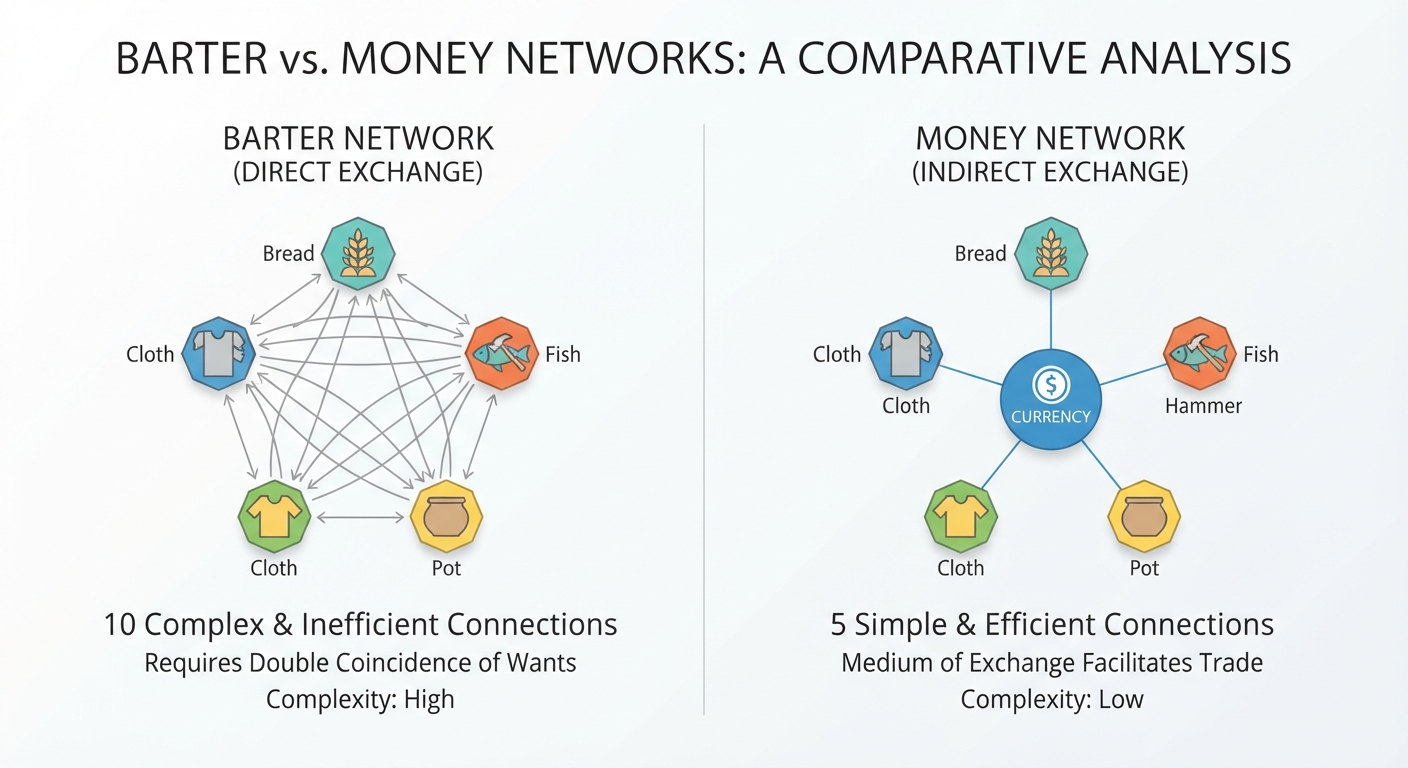
The barter hypothesis: a shared currency reduces the number of price comparisons.
Why would everyone accept silver?
Followers of the economist Carl Menger gave this story its most careful form. In their version, nobody invents money. Some goods, such as salt, cattle or silver, are easier to trade than others, so people accept them even when they don’t need them, knowing they can pass them on. Slowly, one good becomes the one everyone accepts. It is an elegant idea, and it deserves to be taken seriously.
This is how, for some time, the Romans used salt as currency, which is where the word 'salary' comes from. In French, we also use the word 'blé' (wheat/corn) to refer to money, because grain has also frequently served as currency.
This story of the birth of money then makes a prediction: barter came first, then money appeared to fix its problems, and credit came last, as an advanced tool. The story is appealing because it is logical and intuitive. It feels like exactly what we would have done. The problem is that when historians and anthropologists went looking for the evidence, they didn’t find it.
Hypothesis 2: An economy of favours
What if debt came first?
A different view says that debt came first and money second. It was developed mainly by the anthropologist David Graeber, in Debt: The First 5,000 Years (2011), building on the work of Caroline Humphrey and the economist Alfred Mitchell-Innes. Their starting point is that no economy based mostly on barter has ever been documented. Barter does exist, but mostly between strangers, or between people who normally use money and find themselves without it.
Inside early, tight knit communities, you would ask your neighbour for a favour, some bread or some help. They would help you without the need for money or any kind of transaction, and in return you owed them a favour next time. You were in their debt. To be precise, this is not yet debt in the modern sense, because nobody was counting. It was an obligation, a relationship that kept people bound to each other. But it is the seed of what later became debt.
Who kept the accounts?
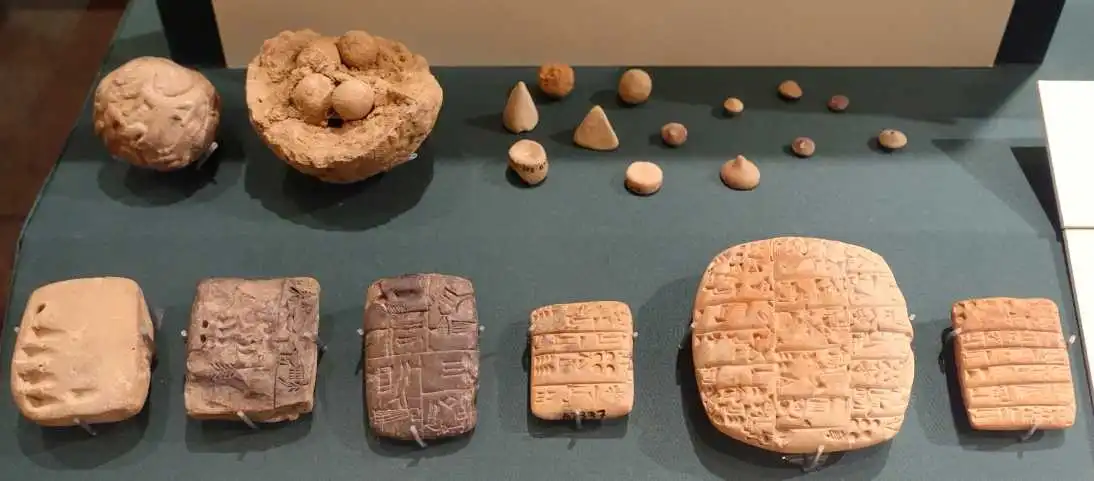
At first, communities were small and debt was remembered, not recorded. However, as communities grew, people could no longer remember all the favours they owed or were owed. Memory had to be replaced by something that lasted. In Mesopotamia, this started with clay tokens, small objects that stood for quantities of grain or animals. Then, the use of clay tablets began.
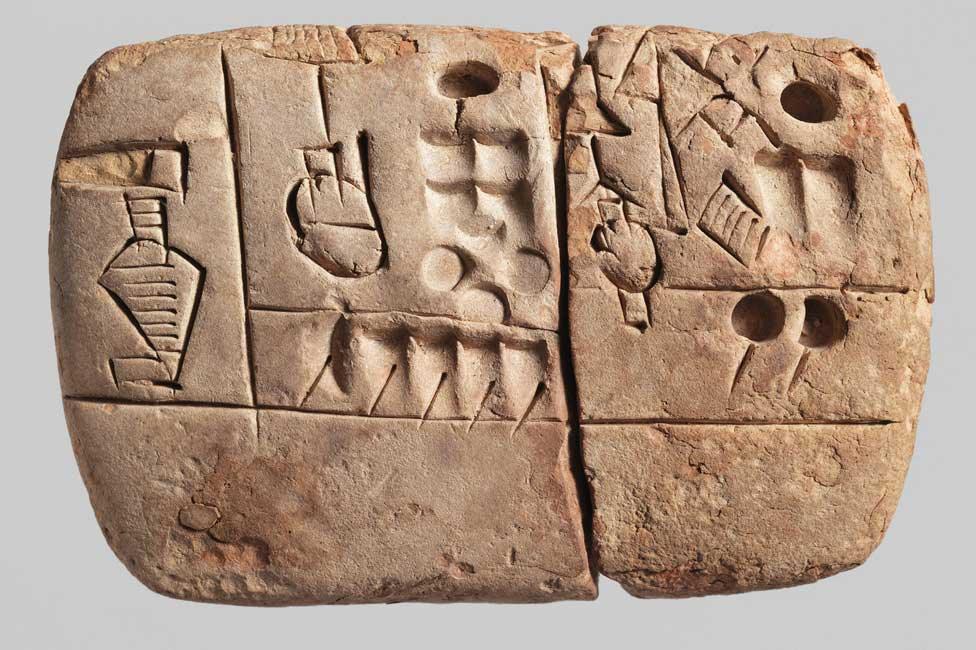
The earliest tablets were not records of neighbours’ favours. They came from temples and palaces, which stored the harvest and lent grain to farmers. A farmer who borrowed seed in spring owed the temple a debt, and he settled it at harvest by handing back barley. The debt was simply cancelled once he had delivered. Each of these debts had to be written down: who borrowed, how much, and when it was due.
As communities grew even larger, debts accumulated, it was unclear what all of this was worth. We needed a unit of measurement. In Mesopotamia, a debt, whatever it was, could be written as an amount of silver or an amount of barley, and now each favour owed and each favour due had a specific value that could be added up. Whoever you borrowed from, whether the temple, a rich household or the tavern keeper who kept your tab, you could now say exactly how much you owed. In fact, most daily purchases, such as beer, were bought on credit and settled at harvest.
Notice also who set the prices. The rate between barley and silver was not discovered by haggling in a market. It was fixed by custom and by the institutions that kept the accounts. This is the opposite of the first story, where prices emerge from people bargaining.
Loans carried interest, which is attested very early in Mesopotamia. The Sumerian word for interest, mash, originally meant “calf”, which suggests it began with loans of livestock and grain, things that multiply by themselves. If I lend you some of my grain and you grow more with it, I expect a share of that growth. So not only was debt invented before coins, but so was interest.
When the system became unbearable, rulers stepped in. Mesopotamian kings periodically cancelled debts, usually at the start of a reign or in a crisis. One of the earliest known examples comes from Urukagina of Lagash, around 2350 BCE. This was not pure generosity: a farmer who lost his land and labour to a wealthy creditor could no longer feed the king’s army or pay his dues. Today, debts are no longer wiped out this way, although bankruptcy and restructuring still exist as similar mechanisms. One reason is that creditors are no longer a small elite: small savers now hold debt, including public debt, through their bank deposits and pensions. Cancelling debt would therefore mean dipping into their savings.
How do banks create money today?
This story of money as debt can also be seen in the recent and modern world. The first banknotes were promises to pay in gold, and they circulated because people trusted the bank that issued them, not because they wanted paper. When the United States ended the dollar’s convertibility into gold in 1971, money did not disappear: it simply became a debt of the central bank and of commercial banks, backed by trust in the state. Today, most money is created when a bank grants a loan. The bank credits your account and records your debt in the same stroke. Your deposit is the bank’s debt to you, your mortgage is your debt to the bank, and when the loan is repaid, that money is literally destroyed.
According to this account, money was born to count debt, not to solve the problems of barter. Barley, for example, first served as a unit of account, long before it changed hands in every purchase. Most daily transactions were still made on credit. Coins only appear around 600 BCE, in Lydia (modern-day Turkey). Stamped by the state, they probably served to pay soldiers and officials, who needed to be able to spend among strangers. Physical money therefore answers a new need: trading with strangers, where debt and trust were no longer enough.
It is important to note that this story is not accepted by everyone, but it is better supported than the first: Smith reasoned his way to his story, whereas the second view starts from the records and fieldwork. Even so, it has serious critics. Followers of Menger argue that a commodity such as silver or salt could still have emerged naturally as a medium of exchange, and Graeber’s critics say he overstates how rare barter was and how early credit appeared. The Mesopotamian sources are also incomplete and open to interpretation. There are also real counterexamples, such as ancient Egypt.
Why it matters
Does the origin of money change anything?
It may look like an academic quarrel about the past, but the way we see money shapes how we think about almost everything built on it.
If money is a thing, a commodity that appeared because it was useful, then it has value in its own right. It is scarce, it has to be protected, and the market found it before any government did. In this view, institutions come second. Debt is a secondary product too, something you take on. The natural conclusion is that money and debt are separate tools.
If money is debt, the picture changes. Money only works because people trust the one who owes it, whether that is a temple, a Crown or a bank. This puts institutions at the center, and makes the question of who issues money and who is allowed to create debt a social and political one. Money and debt stop being only a private matter between two people and becomes part of how a society organizes itself. A debt is a social arrangement, and a society can decide to change it.
What happens when trust breaks?
If money is debt, its value depends on how far we trust whoever owes it. When that trust breaks, people look for a more reliable debtor. In parts of Latin America and Africa, where inflation has repeatedly eroded local currencies, many people save and trade in US dollars instead: Ecuador and El Salvador adopted the dollar officially, and in Argentina or Zimbabwe it circulates widely alongside, or in place of, the national currency.
Others avoid holding money at all. They put their wealth into assets that are nobody’s debt, such as gold, property or shares in companies, whose value does not depend on a single issuer keeping its promises. Each of these choices carries its own risks, though. No asset escapes trust entirely; people simply choose where to place it.